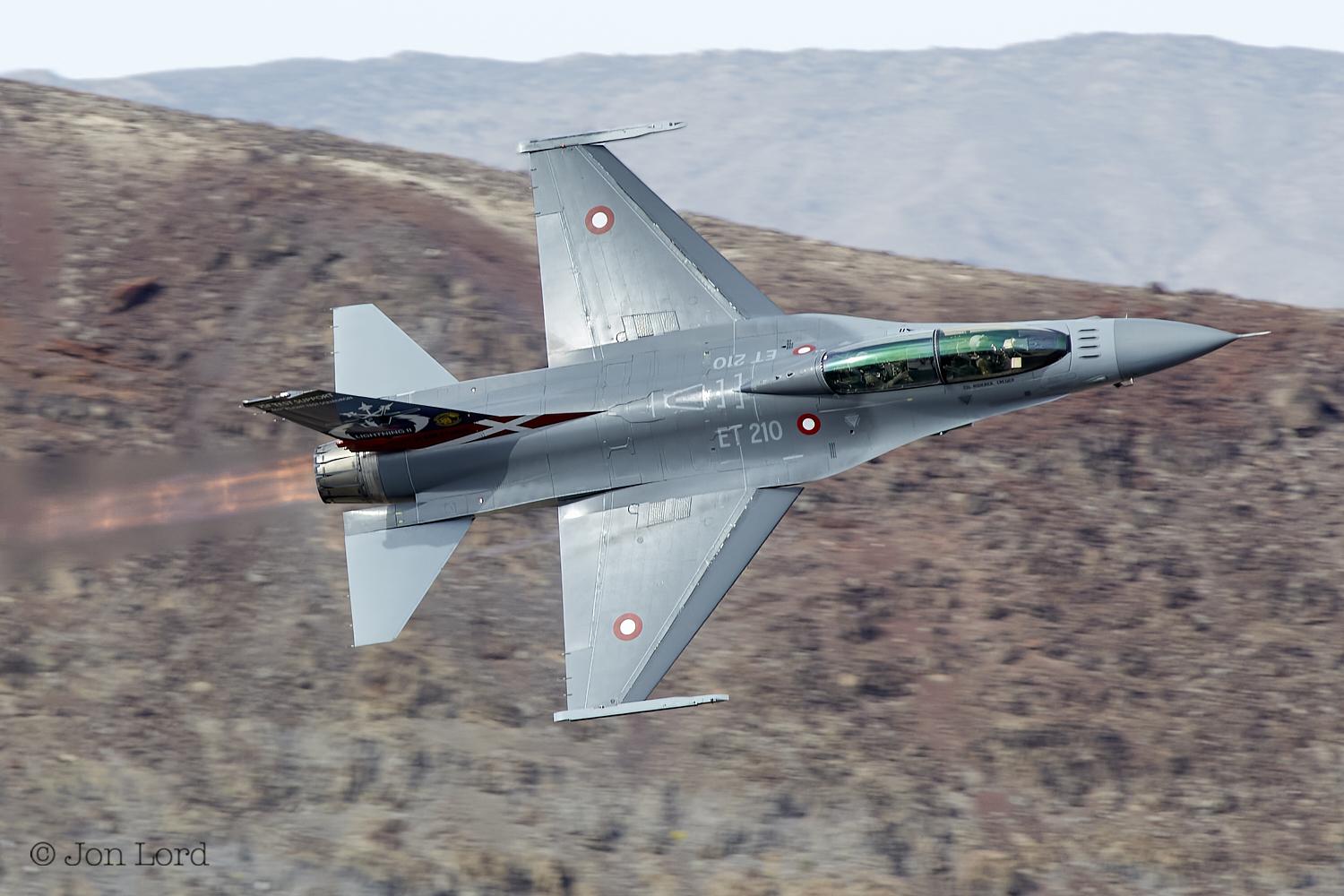
This is a close-up colour photo of a Royal Danish Air Force (Flyvevåbnet) General Dynamics F-16 Fighting Falcon jet fighter accelerating and banking steeply as it climbs out of a desert valley (2015).

Centered in the image is the F-16 climbing and banking (turning) steeply to the right. The aircraft, viewed in profile and flying from left to right,  has a glossy, medium grey colour. The jet has a long, sharp nose with a two seat cockpit behind. Both the pilot and rear seat occupant can be seen clearly through the canopy, each wearing a helmet and oxygen mask. The canopy appears slightly darkened. Aft of the cockpit are two tapered wings with the leading edge slats and trailing edge flaps extended slightly as the wing grips the air. A thin wisp of vapour trial can just be seen on the inboard section of the right wing, again suggesting the wing is working hard. At the rear is the single vertical stabilizer with the Danish flag at the base and a logo filling the rest of the tail. Below are two tapered horizontal stabilizers. Between these is the single engine tail pipe with a bright orange glow behind from the flaming reheat (afterburner). The flame extends some distance behind the aircraft with five shock cones in view. In the near background beyond the jet is a steep, rock covered arid, canyon wall, devoid of any vegetation and coloured red, brown and grey. In the distant background, say 10 km away, is a mountain ridge.

The location: The Mojave Desert, California.
This is a close-up colour photo of a Royal Danish Air Force (Flyvevåbnet) General Dynamics F-16 Fighting Falcon jet fighter accelerating and banking steeply as it climbs out of a desert valley (2015). Centered in the image is the F-16 climbing and banking (turning) steeply to the right. The aircraft, viewed in profile and flying from left to right, has a glossy, medium grey colour. The jet has a long, sharp nose with a two seat cockpit behind. Both the pilot and rear seat occupant can be seen clearly through the canopy, each wearing a helmet and oxygen mask. The canopy appears slightly darkened. Aft of the cockpit are two tapered wings with the leading edge slats and trailing edge flaps extended slightly as the wing grips the air. A thin wisp of vapour trial can just be seen on the inboard section of the right wing, again suggesting the wing is working hard. At the rear is the single vertical stabilizer with the Danish flag at the base and a logo filling the rest of the tail. Below are two tapered horizontal stabilizers. Between these is the single engine tail pipe with a bright orange glow behind from the flaming reheat (afterburner). The flame extends some distance behind the aircraft with five shock cones in view. In the near background beyond the jet is a steep, rock covered arid, canyon wall, devoid of any vegetation and coloured red, brown and grey. In the distant background, say 10 km away, is a mountain ridge. The location: The Mojave Desert, California.
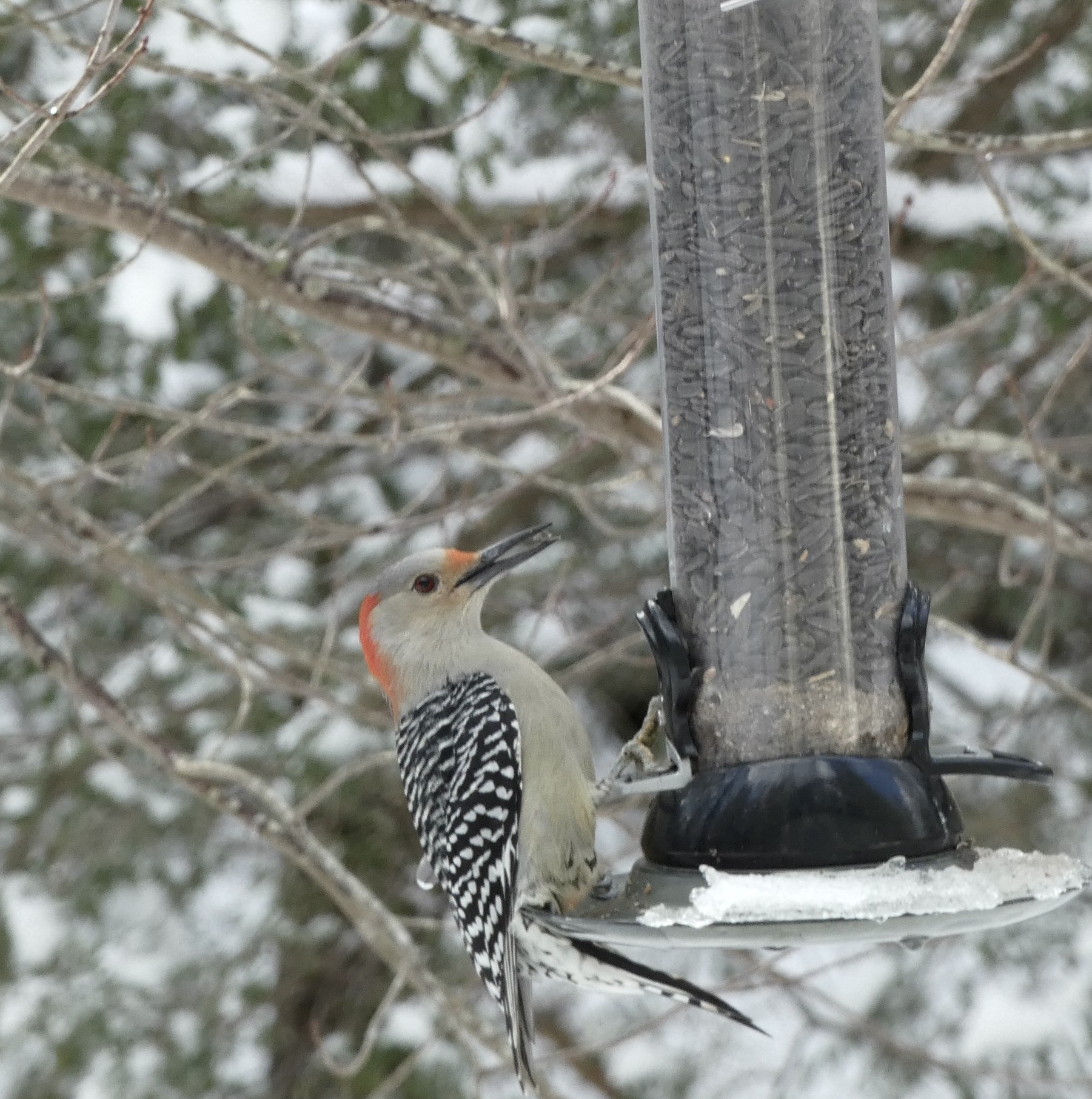
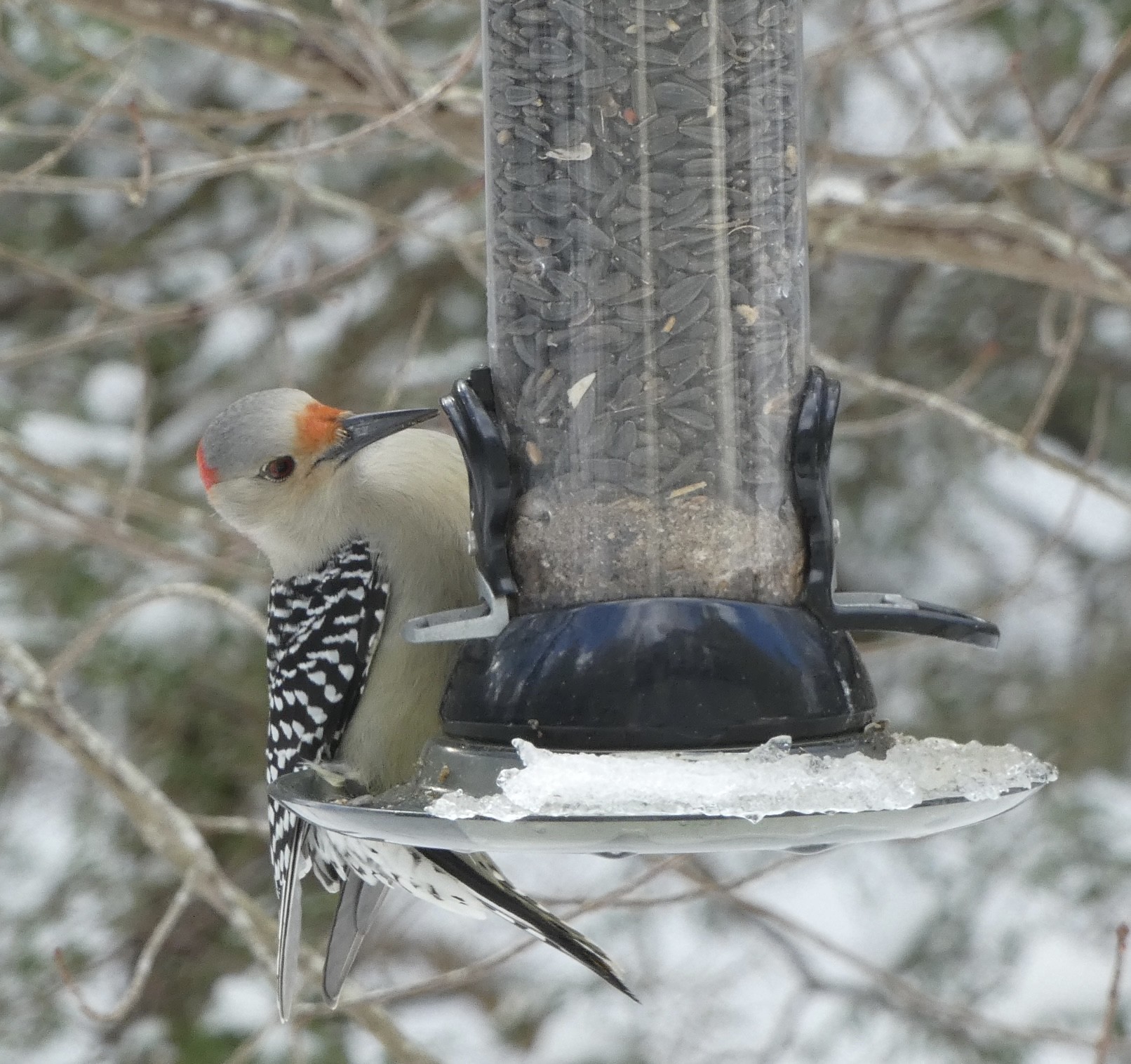
Success! The woodpecker is now leaning back on the feeder as it has pulled a seed out, which can be seen in its needle nose plier beak. The bird is nearly in profile as one of its feet still grasps the metal perch off the feeder (which it cannot use to sit as the bird is too large.)
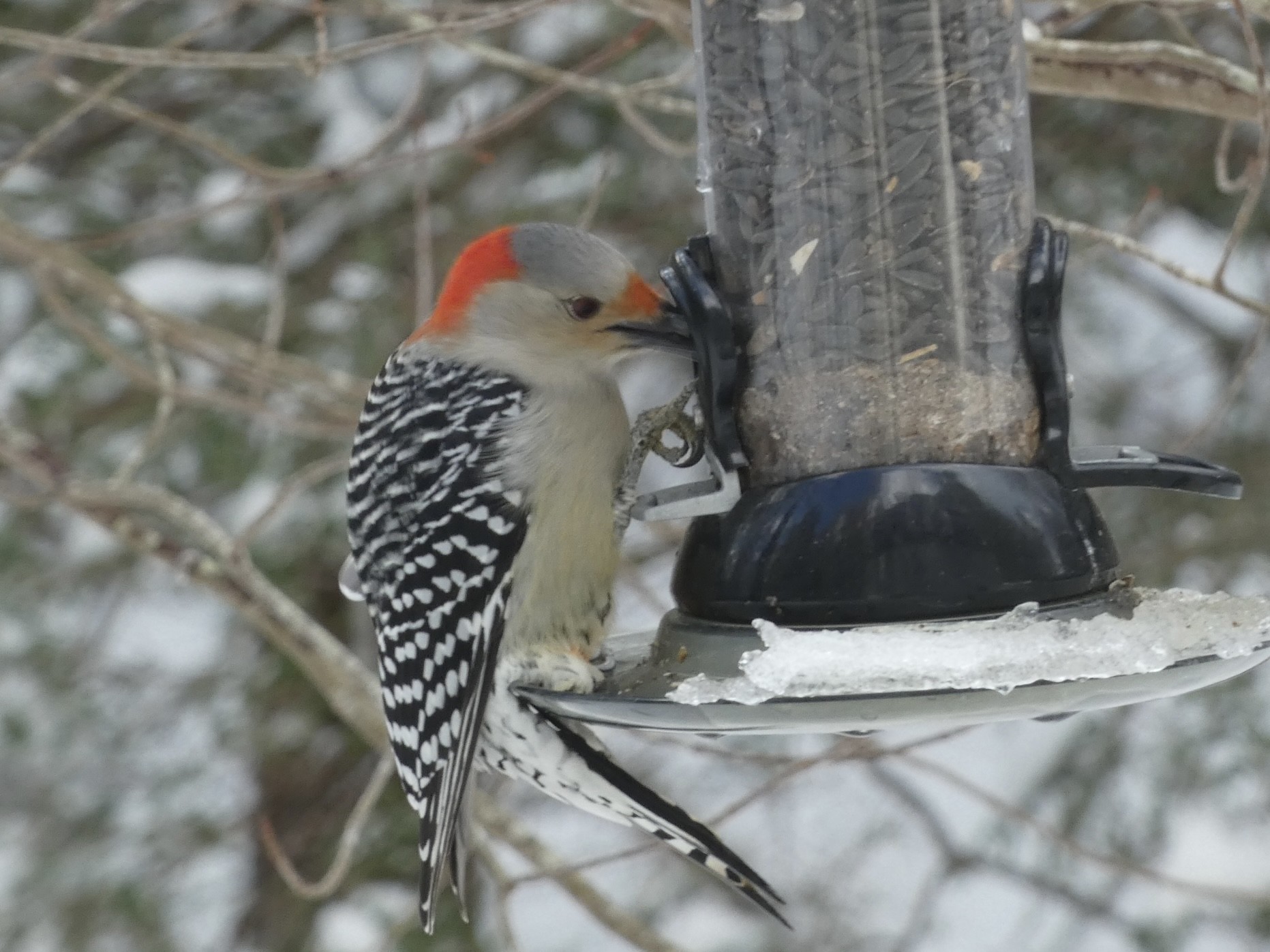
A medium sized woodpecker is precariously perched on a hanging tube bird feeder. It is a little large to be using this feeder so it is somewhat crouched down, trying to strategize how to put its longish beak into the opening. Red-bellied Woodpeckers are infuriatingly named because it is seldom that you actually see the red belly. But it does have a red patch atop its head and an orange blotch where its beak connects to its head. Its wings are a smattering of black and white feathers.
Abstract photograph created using a single photo of fall sumac leaves and sumac branches. The sumac leaves extend along either side of a slender branch. Fall sumac leaves range from red to orange to yellow and in various combinations of those three colors. The photo is created by copying the original and then flipping the copy horizontally. The original and the copy are joined at the flip point and then both are copied, flipped vertically, and the resulting copies are then joined at the flip point. The result is four-quadrant image with each quadrant a mirror of the quadrants opposing it. The appearance is similar to what one would see in a four-mirror kaleidoscope. In addition to the realistic objects in each photo, the process creates multiple abstract objects especially at or near where one photo attaches to another.