Page from A People's History of the United States:
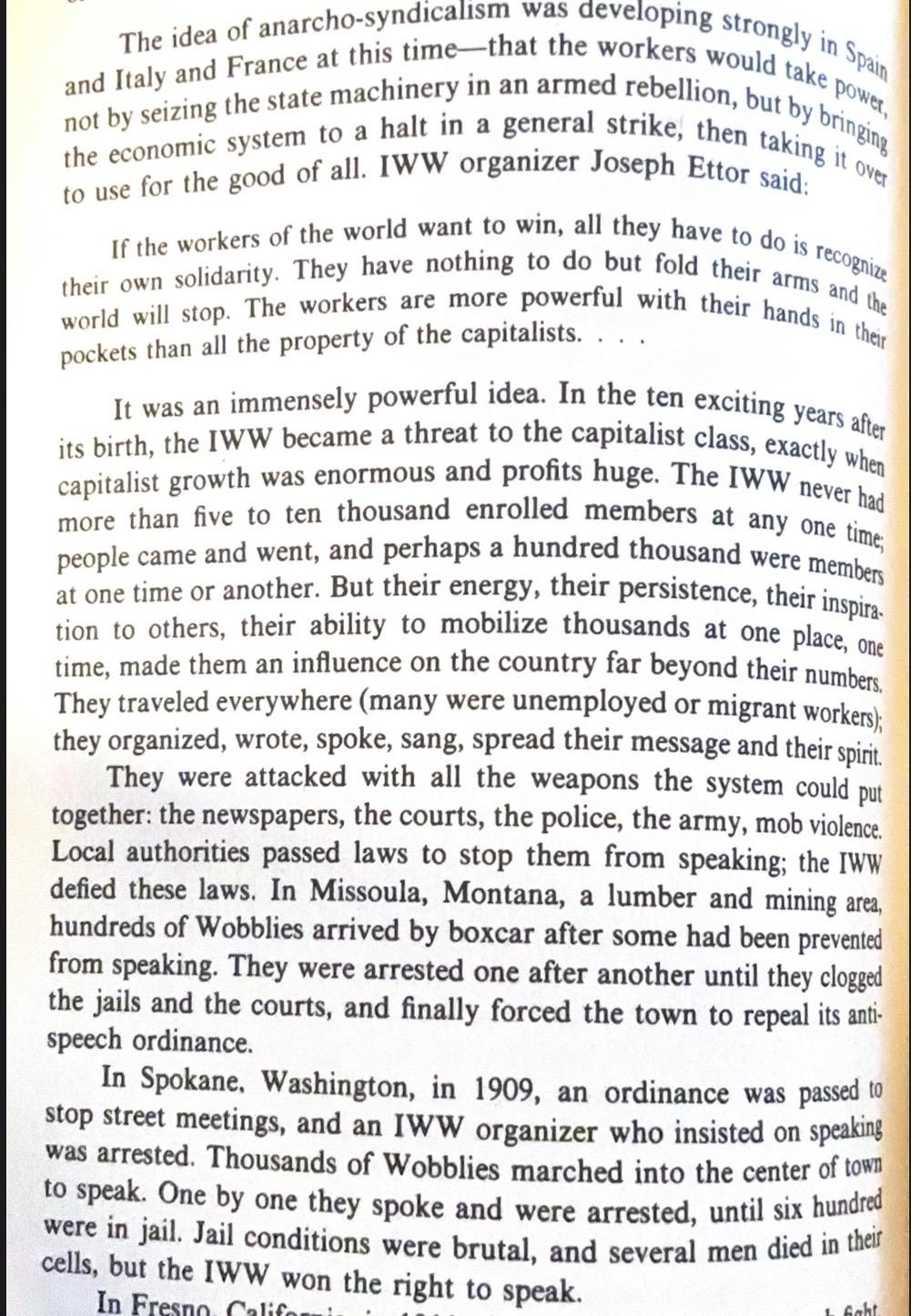
The idea of anarcho-syndicalism was developing strongly in Spain and Italy and France at this time-that the workers would take power, not by seizing the state machinery in an armed rebellion, but by bringing the economic system to a halt in a general strike, then taking it over to use for the good of all. IWW organizer Joseph Ettor said:

If the workers of the world want to win, all they have to do is recognize their own solidarity. They have nothing to do but fold their arms and the world will stop. The workers are more powerful with their hands in their
pockets than all the property of the capitalists..

It was an immensely powerful idea. In the ten exciting years after its birth, the IW became a threat to the capitalist class, exactly when capitalist growth was enormous and profits huge. The IWW never had more than five to ten thousand enrolled members at any one time; people came and went, and perhaps a hundred thousand were members at one time or another. But their energy, their persistence, their inspira, tion to others, their ability to mobilize thousands at one place, one time, made them an influence on the country far beyond their numbers They traveled everywhere (many were unemployed or migrant workers); they organized, wrote, spoke, sang, spread their message and their spirit.

They were attacked with all the weapons the system could put together: the newspapers, the courts, the police, the army, mob violence.
Page from A People's History of the United States: The idea of anarcho-syndicalism was developing strongly in Spain and Italy and France at this time-that the workers would take power, not by seizing the state machinery in an armed rebellion, but by bringing the economic system to a halt in a general strike, then taking it over to use for the good of all. IWW organizer Joseph Ettor said: If the workers of the world want to win, all they have to do is recognize their own solidarity. They have nothing to do but fold their arms and the world will stop. The workers are more powerful with their hands in their pockets than all the property of the capitalists.. It was an immensely powerful idea. In the ten exciting years after its birth, the IW became a threat to the capitalist class, exactly when capitalist growth was enormous and profits huge. The IWW never had more than five to ten thousand enrolled members at any one time; people came and went, and perhaps a hundred thousand were members at one time or another. But their energy, their persistence, their inspira, tion to others, their ability to mobilize thousands at one place, one time, made them an influence on the country far beyond their numbers They traveled everywhere (many were unemployed or migrant workers); they organized, wrote, spoke, sang, spread their message and their spirit. They were attacked with all the weapons the system could put together: the newspapers, the courts, the police, the army, mob violence.
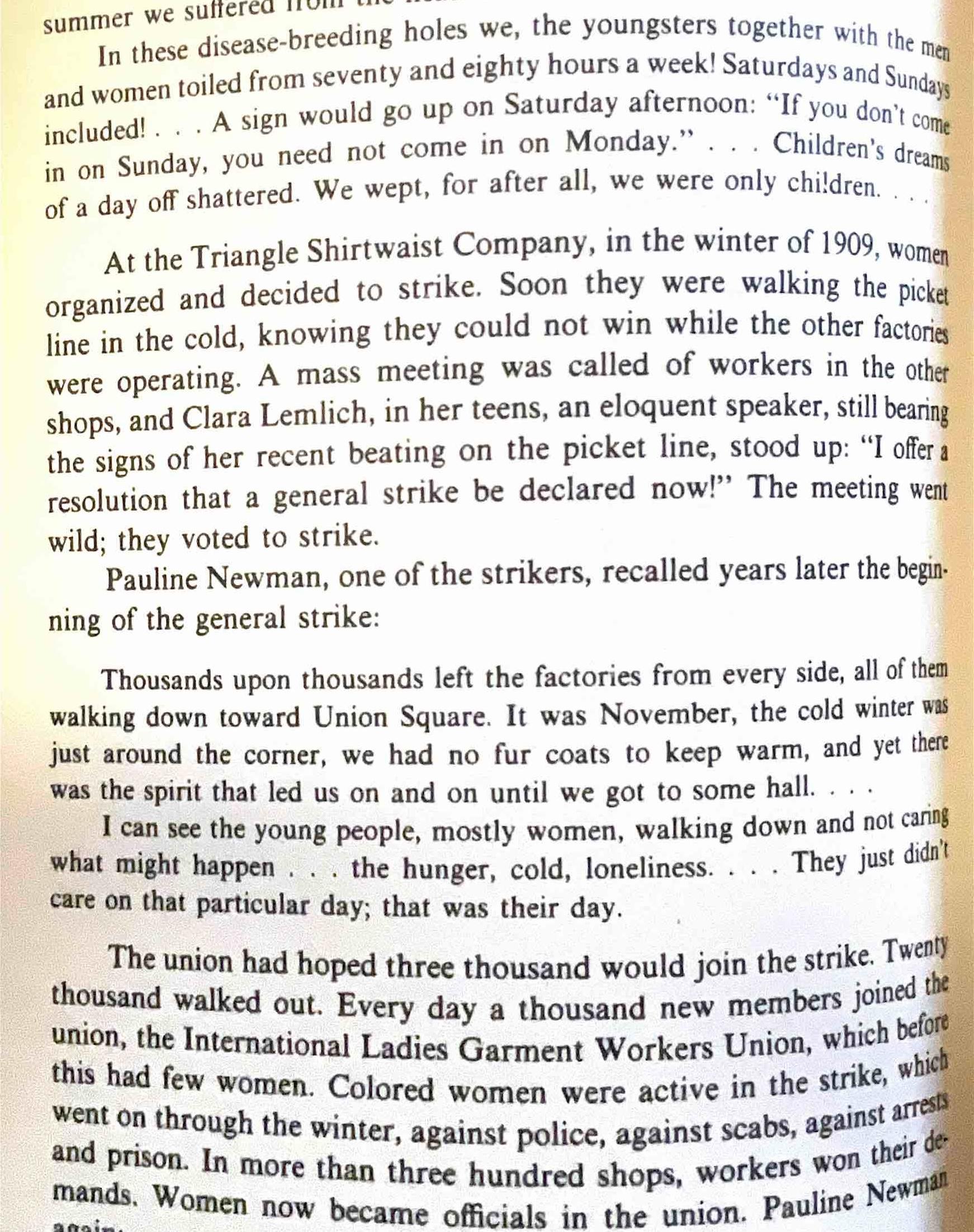
A page from A People's History of the United States:

At the Triangle Shirtwaist Company, in the winter of 1909, women organized and decided to strike. Soon they were walking the picket line in the cold, knowing they could not win while the other factories were operating. A mass meeting was called of workers in the other shops, and Clara Lemlich, in her teens, an eloquent speaker, still bearing the signs of her recent beating on the picket line, stood up: "I offer a resolution that a general strike be declared now!" The meeting went wild; they voted to strike.

Pauline Newman, one of the strikers, recalled years later the begin.
ning of the general strike:

Thousands upon thousands left the factories from every side, all of them walking down toward Union Square. It was November, the cold winter was just around the corner, we had no fur coats to keep warm, and yet there was the spirit that led us on and on until we got to some hall....

I can see the young people, mostly women, walking down and not caring what might happen... the hunger, cold, loneliness.... They just didn't care on that particular day; that was their day.

The union had hoped three thousand would join the strike. Twenty thousand walked out. Every day a thousand new members joined the union, the International Ladies Garment Workers Union, which before this had few women. Colored women were active in the strike, which went on through
A page from A People's History of the United States: At the Triangle Shirtwaist Company, in the winter of 1909, women organized and decided to strike. Soon they were walking the picket line in the cold, knowing they could not win while the other factories were operating. A mass meeting was called of workers in the other shops, and Clara Lemlich, in her teens, an eloquent speaker, still bearing the signs of her recent beating on the picket line, stood up: "I offer a resolution that a general strike be declared now!" The meeting went wild; they voted to strike. Pauline Newman, one of the strikers, recalled years later the begin. ning of the general strike: Thousands upon thousands left the factories from every side, all of them walking down toward Union Square. It was November, the cold winter was just around the corner, we had no fur coats to keep warm, and yet there was the spirit that led us on and on until we got to some hall.... I can see the young people, mostly women, walking down and not caring what might happen... the hunger, cold, loneliness.... They just didn't care on that particular day; that was their day. The union had hoped three thousand would join the strike. Twenty thousand walked out. Every day a thousand new members joined the union, the International Ladies Garment Workers Union, which before this had few women. Colored women were active in the strike, which went on through
12
9
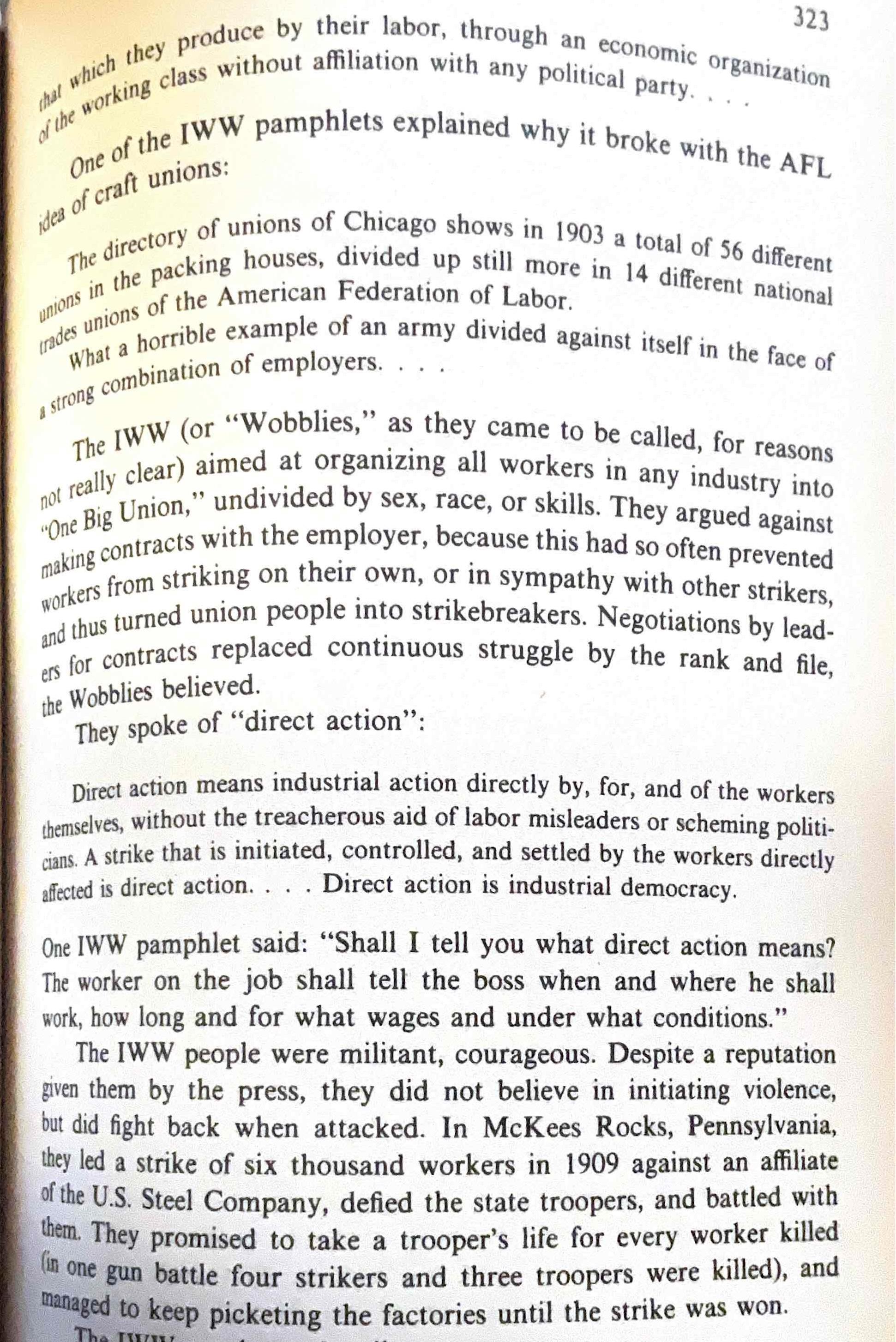
Page from A People's History of the United States:

that which they produce by their labor, through an economic organization of the working class without affiliation with any political party....
idea of craft unions:

One of the IWW pamphlets explained why it broke with the AFL
The directory of unions of Chicago shows in 1903 a total of 56 different trades unions of the American Federation of Labor. unions in the packing houses, divided up still more in 14 different national What a horrible example of an army divided against itself in the face of a strong combination of employers...

The IWW (or "Wobblies," as they came to be called, for reasons not really clear) aimed at organizing all workers in any industry into "One Big Union," undivided by sex, race, or skills. They argued against making contracts with the employer, because this had so often prevented workers from striking on their own, or in sympathy with other strikers, and thus turned union people into strikebreakers. Negotiations by lead-es for contracts replaced continuous struggle by the rank and file, the Wobblies believed. They spoke of "direct action":

Direct action means industrial action directly by, for, and of the workers themselves, without the treacherous aid of labor misleaders or scheming politi-cians. A strike that is initiated, controlled, and settled by the workers directly afected is direct action... Direct action is industrial democracy.
One IWW pamphlet said: "Shall I tell you what direct action..
Page from A People's History of the United States: that which they produce by their labor, through an economic organization of the working class without affiliation with any political party.... idea of craft unions: One of the IWW pamphlets explained why it broke with the AFL The directory of unions of Chicago shows in 1903 a total of 56 different trades unions of the American Federation of Labor. unions in the packing houses, divided up still more in 14 different national What a horrible example of an army divided against itself in the face of a strong combination of employers... The IWW (or "Wobblies," as they came to be called, for reasons not really clear) aimed at organizing all workers in any industry into "One Big Union," undivided by sex, race, or skills. They argued against making contracts with the employer, because this had so often prevented workers from striking on their own, or in sympathy with other strikers, and thus turned union people into strikebreakers. Negotiations by lead-es for contracts replaced continuous struggle by the rank and file, the Wobblies believed. They spoke of "direct action": Direct action means industrial action directly by, for, and of the workers themselves, without the treacherous aid of labor misleaders or scheming politi-cians. A strike that is initiated, controlled, and settled by the workers directly afected is direct action... Direct action is industrial democracy. One IWW pamphlet said: "Shall I tell you what direct action..
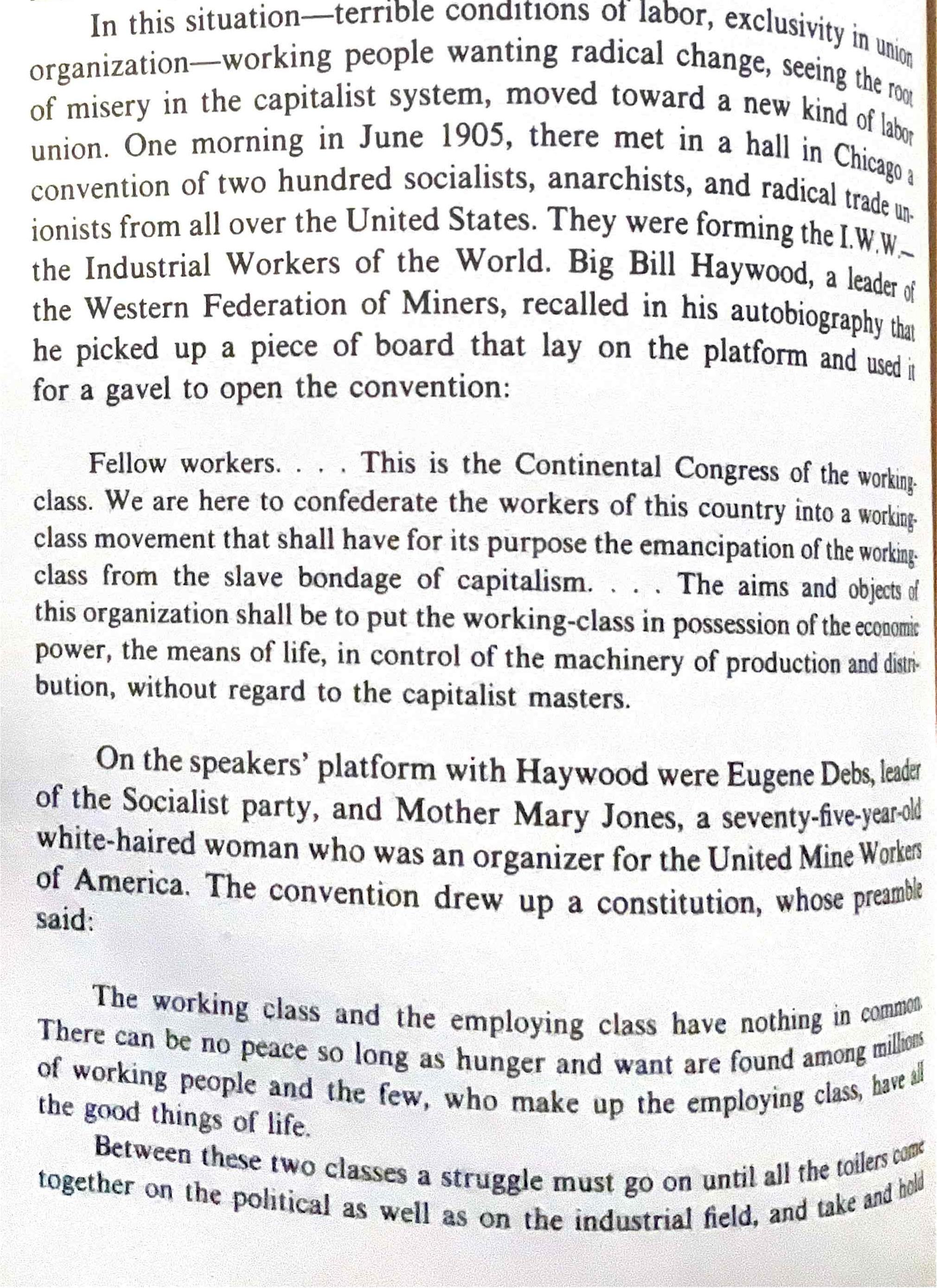
Page from Howard Zinn's A People's History of the United States:One morning in June 1905, there met in a hall in Chicago a convention of two hundred socialists, anarchists, and radical trade unionists from all over the United States. They were forming the I.W. W-the Industrial Workers of the World. Big Bill Haywood, a leader of the Western Federation of Miners, recalled in his autobiography that he picked up a piece of board that lay on the platform and used it for a gavel to open the convention:

Fellow workers.... This is the Continental Congress of the working class. We are here to confederate the workers of this country into a working-class movement that shall have for its purpose the emancipation of the working: class from the slave bondage of capitalism.... The aims and objects of this organization shall be to put the working-class in possession of the economic power, the means of life, in control of the machinery of production and dist-bution, without regard to the capitalist masters.

On the speakers' platform with Haywood were Eugene Debs, leader of the Socialist party, and Mother Mary Jones, a seventy-five-year-old white-haired woman who was an organizer for the United Mine Workes of America. The convention drew up a constitution, whose preamble said:

The working class and the employing class have nothing in common There can be no peace so long as hunger and want are found among millions of working people and the few, who make up the employing class, have al
the...
Page from Howard Zinn's A People's History of the United States:One morning in June 1905, there met in a hall in Chicago a convention of two hundred socialists, anarchists, and radical trade unionists from all over the United States. They were forming the I.W. W-the Industrial Workers of the World. Big Bill Haywood, a leader of the Western Federation of Miners, recalled in his autobiography that he picked up a piece of board that lay on the platform and used it for a gavel to open the convention: Fellow workers.... This is the Continental Congress of the working class. We are here to confederate the workers of this country into a working-class movement that shall have for its purpose the emancipation of the working: class from the slave bondage of capitalism.... The aims and objects of this organization shall be to put the working-class in possession of the economic power, the means of life, in control of the machinery of production and dist-bution, without regard to the capitalist masters. On the speakers' platform with Haywood were Eugene Debs, leader of the Socialist party, and Mother Mary Jones, a seventy-five-year-old white-haired woman who was an organizer for the United Mine Workes of America. The convention drew up a constitution, whose preamble said: The working class and the employing class have nothing in common There can be no peace so long as hunger and want are found among millions of working people and the few, who make up the employing class, have al the...
Page from A People's History of the United States:
The idea of anarcho-syndicalism was developing strongly in Spain and Italy and France at this time-that the workers would take power, not by seizing the state machinery in an armed rebellion, but by bringing the economic system to a halt in a general strike, then taking it over to use for the good of all. IWW organizer Joseph Ettor said:

If the workers of the world want to win, all they have to do is recognize their own solidarity. They have nothing to do but fold their arms and the world will stop. The workers are more powerful with their hands in their
pockets than all the property of the capitalists..

It was an immensely powerful idea. In the ten exciting years after its birth, the IW became a threat to the capitalist class, exactly when capitalist growth was enormous and profits huge. The IWW never had more than five to ten thousand enrolled members at any one time; people came and went, and perhaps a hundred thousand were members at one time or another. But their energy, their persistence, their inspira, tion to others, their ability to mobilize thousands at one place, one time, made them an influence on the country far beyond their numbers They traveled everywhere (many were unemployed or migrant workers); they organized, wrote, spoke, sang, spread their message and their spirit.

They were attacked with all the weapons the system could put together: the newspapers, the courts, the police, the army, mob violence.
Page from A People's History of the United States: The idea of anarcho-syndicalism was developing strongly in Spain and Italy and France at this time-that the workers would take power, not by seizing the state machinery in an armed rebellion, but by bringing the economic system to a halt in a general strike, then taking it over to use for the good of all. IWW organizer Joseph Ettor said: If the workers of the world want to win, all they have to do is recognize their own solidarity. They have nothing to do but fold their arms and the world will stop. The workers are more powerful with their hands in their pockets than all the property of the capitalists.. It was an immensely powerful idea. In the ten exciting years after its birth, the IW became a threat to the capitalist class, exactly when capitalist growth was enormous and profits huge. The IWW never had more than five to ten thousand enrolled members at any one time; people came and went, and perhaps a hundred thousand were members at one time or another. But their energy, their persistence, their inspira, tion to others, their ability to mobilize thousands at one place, one time, made them an influence on the country far beyond their numbers They traveled everywhere (many were unemployed or migrant workers); they organized, wrote, spoke, sang, spread their message and their spirit. They were attacked with all the weapons the system could put together: the newspapers, the courts, the police, the army, mob violence.
A page from A People's History of the United States:

At the Triangle Shirtwaist Company, in the winter of 1909, women organized and decided to strike. Soon they were walking the picket line in the cold, knowing they could not win while the other factories were operating. A mass meeting was called of workers in the other shops, and Clara Lemlich, in her teens, an eloquent speaker, still bearing the signs of her recent beating on the picket line, stood up: "I offer a resolution that a general strike be declared now!" The meeting went wild; they voted to strike.

Pauline Newman, one of the strikers, recalled years later the begin.
ning of the general strike:

Thousands upon thousands left the factories from every side, all of them walking down toward Union Square. It was November, the cold winter was just around the corner, we had no fur coats to keep warm, and yet there was the spirit that led us on and on until we got to some hall....

I can see the young people, mostly women, walking down and not caring what might happen... the hunger, cold, loneliness.... They just didn't care on that particular day; that was their day.

The union had hoped three thousand would join the strike. Twenty thousand walked out. Every day a thousand new members joined the union, the International Ladies Garment Workers Union, which before this had few women. Colored women were active in the strike, which went on through
A page from A People's History of the United States: At the Triangle Shirtwaist Company, in the winter of 1909, women organized and decided to strike. Soon they were walking the picket line in the cold, knowing they could not win while the other factories were operating. A mass meeting was called of workers in the other shops, and Clara Lemlich, in her teens, an eloquent speaker, still bearing the signs of her recent beating on the picket line, stood up: "I offer a resolution that a general strike be declared now!" The meeting went wild; they voted to strike. Pauline Newman, one of the strikers, recalled years later the begin. ning of the general strike: Thousands upon thousands left the factories from every side, all of them walking down toward Union Square. It was November, the cold winter was just around the corner, we had no fur coats to keep warm, and yet there was the spirit that led us on and on until we got to some hall.... I can see the young people, mostly women, walking down and not caring what might happen... the hunger, cold, loneliness.... They just didn't care on that particular day; that was their day. The union had hoped three thousand would join the strike. Twenty thousand walked out. Every day a thousand new members joined the union, the International Ladies Garment Workers Union, which before this had few women. Colored women were active in the strike, which went on through
12