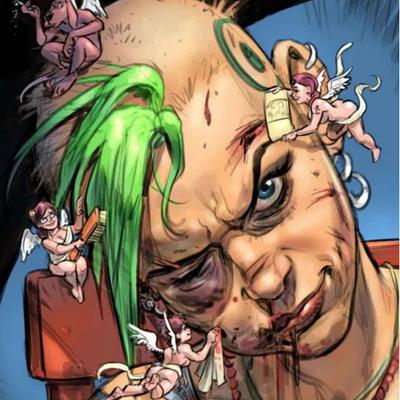
Job and wealth creation. Cartoon from last year.

1
#Tag
Job and wealth creation. Cartoon from last year.

2/2 #screed #uspol #capitalism #doom
The favored few amongst us rabble will live somewhat better as the social pets of their masters, but everyone else will continue to struggle to subsist and own nothing; receiving just enough to allow them to live and purchase the goods created by the machine and no more. The mean minimum, which will be less in many cases than they have now. They will be subjugated, told if they want better to pull themselves up by their own boostraps. But they will have no boostraps. The oligarchs have taken all the boostraps away.
Except as seen in a Star Trek future, capitalism demands someone to buy the goods or you have demand collapse. Plain and simple. And democracy cannot exist there. People cannot thrive there, only subsist. The machine must be fed, the machine requires upkeep and maintenance and raw materials, the machine demands its pound of fle$h. The wealthy owners of the machine, the only ones now capable of owning the machine, never again can it be you, are not going to run the machine as a charity.
Let's be frank here, the same people fighting to keep us all from having universal health care... those same people (and their owned political proxies) are not going to just turn around and give the masses a real piece of the pie. People like Elon Musk and Jeff Bezos and Larry Ellison are not going to become benevolent tomorrow. So you have health 'insurance' - at a higher cost than health 'care' elsewhere in the world - which you must purchase because... we can't have demand collapse, now can we.
2/2
Thanks for coming to my Doom Talk
1/2 I somehow previously managed to edit this #screed to it fit in one toot and then I lost it. Here is the bloated version, probably much less cogent.
#uspol #capitalism #doom
The extreme version of capitalism that we in the USA find ourselves under is not compatible with democracy. Full stop.
The few control the many. And the few are now eyeing how to remove the many from the workings of society and turn them, figuratively, into fuel for their machines rather than cogs which can move within the machine. The new machines become the new cogs in the larger machine.
Does a new 'machine' (I use this figuratively) provide for the public good or does it merely increase unemployment and redistribute wealth upwards? This is the question we should always be focusing on while we still command a small amount of agency in the larger machine.
Luxury, a pejorative at various times in history, has been held out to us by the gloved hand of our oligarch masters to sell us on the idea that we are actually participants in the rewards and not, in fact, the product. A slick new phone, a large(r) TV, and nice cars (largely owned by banks owned by oligarchs) give us the perception of participation. And perhaps if you're favored enough, you [and said bank] might even purchase a home. You are more servile than serviced, and the basic need for health care is expensive or denied; No public pooling, no collective bargaining. You send them money and get only what they will allow after profits.
Meanwhile the masters own small nations, own the people who run the ones too large to own, and their yachts are bigger than than the home you struggled to buy (more or less). And one of those oligarchs, for that is what they are, is poised to soon become the world's first trillionaire if the current 'number go up' wealth inequity trend continues. The wealth comes from somewhere, and that somewhere is you.
Talk of Universal Basic Income sounds utopic, but only if it's the Star Trek kind 'evenly distributed', not what's most likely: A 2 or 3 (or god help us 4) tiered system much like we have now, except more of the wealth will float upwards, less and less downward.
1/2
1/2 I somehow previously managed to edit this #screed to it fit in one toot and then I lost it. Here is the bloated version, probably much less cogent.
#uspol #capitalism #doom
The extreme version of capitalism that we in the USA find ourselves under is not compatible with democracy. Full stop.
The few control the many. And the few are now eyeing how to remove the many from the workings of society and turn them, figuratively, into fuel for their machines rather than cogs which can move within the machine. The new machines become the new cogs in the larger machine.
Does a new 'machine' (I use this figuratively) provide for the public good or does it merely increase unemployment and redistribute wealth upwards? This is the question we should always be focusing on while we still command a small amount of agency in the larger machine.
Luxury, a pejorative at various times in history, has been held out to us by the gloved hand of our oligarch masters to sell us on the idea that we are actually participants in the rewards and not, in fact, the product. A slick new phone, a large(r) TV, and nice cars (largely owned by banks owned by oligarchs) give us the perception of participation. And perhaps if you're favored enough, you [and said bank] might even purchase a home. You are more servile than serviced, and the basic need for health care is expensive or denied; No public pooling, no collective bargaining. You send them money and get only what they will allow after profits.
Meanwhile the masters own small nations, own the people who run the ones too large to own, and their yachts are bigger than than the home you struggled to buy (more or less). And one of those oligarchs, for that is what they are, is poised to soon become the world's first trillionaire if the current 'number go up' wealth inequity trend continues. The wealth comes from somewhere, and that somewhere is you.
Talk of Universal Basic Income sounds utopic, but only if it's the Star Trek kind 'evenly distributed', not what's most likely: A 2 or 3 (or god help us 4) tiered system much like we have now, except more of the wealth will float upwards, less and less downward.
1/2
2/2 #screed #uspol #capitalism #doom
The favored few amongst us rabble will live somewhat better as the social pets of their masters, but everyone else will continue to struggle to subsist and own nothing; receiving just enough to allow them to live and purchase the goods created by the machine and no more. The mean minimum, which will be less in many cases than they have now. They will be subjugated, told if they want better to pull themselves up by their own boostraps. But they will have no boostraps. The oligarchs have taken all the boostraps away.
Except as seen in a Star Trek future, capitalism demands someone to buy the goods or you have demand collapse. Plain and simple. And democracy cannot exist there. People cannot thrive there, only subsist. The machine must be fed, the machine requires upkeep and maintenance and raw materials, the machine demands its pound of fle$h. The wealthy owners of the machine, the only ones now capable of owning the machine, never again can it be you, are not going to run the machine as a charity.
Let's be frank here, the same people fighting to keep us all from having universal health care... those same people (and their owned political proxies) are not going to just turn around and give the masses a real piece of the pie. People like Elon Musk and Jeff Bezos and Larry Ellison are not going to become benevolent tomorrow. So you have health 'insurance' - at a higher cost than health 'care' elsewhere in the world - which you must purchase because... we can't have demand collapse, now can we.
2/2
Thanks for coming to my Doom Talk
1/2 I somehow previously managed to edit this #screed to it fit in one toot and then I lost it. Here is the bloated version, probably much less cogent.
#uspol #capitalism #doom
The extreme version of capitalism that we in the USA find ourselves under is not compatible with democracy. Full stop.
The few control the many. And the few are now eyeing how to remove the many from the workings of society and turn them, figuratively, into fuel for their machines rather than cogs which can move within the machine. The new machines become the new cogs in the larger machine.
Does a new 'machine' (I use this figuratively) provide for the public good or does it merely increase unemployment and redistribute wealth upwards? This is the question we should always be focusing on while we still command a small amount of agency in the larger machine.
Luxury, a pejorative at various times in history, has been held out to us by the gloved hand of our oligarch masters to sell us on the idea that we are actually participants in the rewards and not, in fact, the product. A slick new phone, a large(r) TV, and nice cars (largely owned by banks owned by oligarchs) give us the perception of participation. And perhaps if you're favored enough, you [and said bank] might even purchase a home. You are more servile than serviced, and the basic need for health care is expensive or denied; No public pooling, no collective bargaining. You send them money and get only what they will allow after profits.
Meanwhile the masters own small nations, own the people who run the ones too large to own, and their yachts are bigger than than the home you struggled to buy (more or less). And one of those oligarchs, for that is what they are, is poised to soon become the world's first trillionaire if the current 'number go up' wealth inequity trend continues. The wealth comes from somewhere, and that somewhere is you.
Talk of Universal Basic Income sounds utopic, but only if it's the Star Trek kind 'evenly distributed', not what's most likely: A 2 or 3 (or god help us 4) tiered system much like we have now, except more of the wealth will float upwards, less and less downward.
1/2
The US has always been about violent conquest and profit seeking for capitalists. That is the core. And of course, almost exclusively against brown people. White supremacy, capitalism, murder and theft. And now open fascism. That is the United States of America.
From Howard Zinn's "The People's History of the United States", chapter 12, The Empire and the People"
#US #Capitalism #Colonialism #Empire #Imperialism #War #Violence #Fascism
![Aires to protect American interests during a revolution.
1852-53-Argentina. Marines were landed and maintained in Buenos
153- Nicaragua- 10 protect American lves and interests during political
disturbances.
1853-54—Japan-The "Opening of Japan" and the Perry Expedition.
(The State Department does not give more details, but this involved the use of warships to force Japan to open its ports to the United States.] 1853-54—Ryukyu and Bonin Islands-Commodore Perry on three visits before going to Japan and while waiting for a reply from Japan made a naval demonstration, landing marines twice, and secured a coaling concession from the ruler of Naha on Okinawa. He also demonstrated in the Bonin Islands.
All to secure facilities for commerce.
1854—Nicaragua-San Juan del Norte Greytown was destroyed to avenge an insult to the American Minister to Nicaragua.]
1855-Uruguay—U.S. and European naval forces landed to protect American interests during an attempted revolution in Montevideo.
1859-China-For the protection of American interests in Shanghai. 1860Angola, Portuguese West Africa-To protect American lives and
property at Kissembo when the natives became troublesome.
1893—Hawaii—Ostensibly to protect American lives and property; actually to promote a provisional government under Sanford B. Dole. This action was disavowed by the United States.
1894 Nicaragua-To protect American interests at Bluefields following a revolution.](https://social-coop-media.ams3.cdn.digitaloceanspaces.com/media_attachments/files/115/866/596/462/934/990/original/0f2ecd04dd67ade1.jpeg)
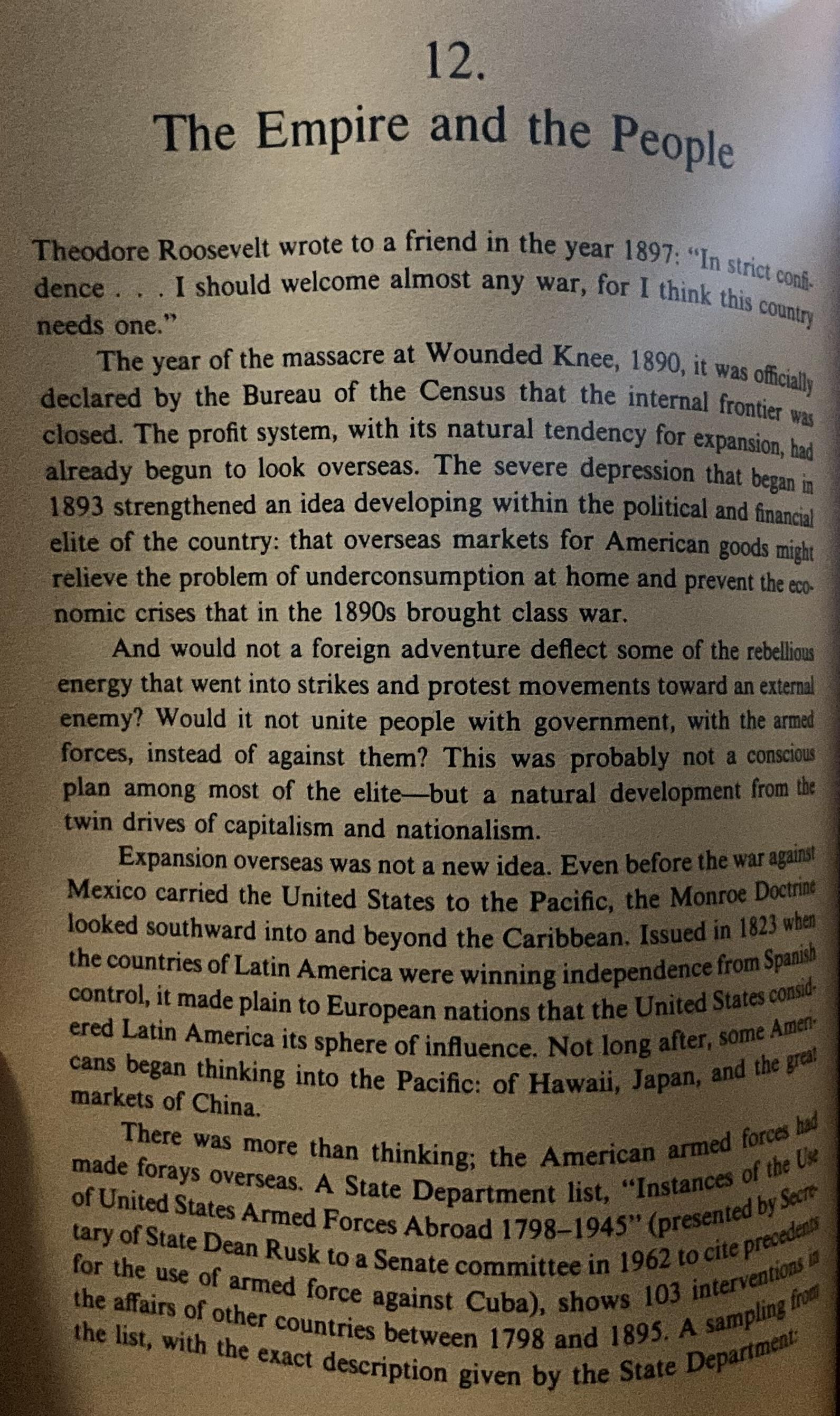
The US has always been about violent conquest and profit seeking for capitalists. That is the core. And of course, almost exclusively against brown people. White supremacy, capitalism, murder and theft. And now open fascism. That is the United States of America.
From Howard Zinn's "The People's History of the United States", chapter 12, The Empire and the People"
#US #Capitalism #Colonialism #Empire #Imperialism #War #Violence #Fascism
"A grave violation of rules-based international law
The U.S. capture of Venezuelan President Nicolás Maduro and the associated military operation were widely condemned by legal experts and several nations as a violation of international law, specifically the UN Charter, which prohibits the use of force against the territorial integrity or political independence of another state."
#Imperialism #Venezuela #Empire #Colonialism #Oil #War #Capitalism #Fascism
https://www.juancole.com/2026/01/venezuela-american-international.html
This is a Bonfire Federated social instance for those that enjoy gnarly adventures. Whether it's shredding mountains or slaying guitars, from action sports to art.